Saturday, February 2, 2013


On a typical day, I wake up to the sound of roosters, not because roosters only crow in the early morning; I know that to be completely false now. However, I have to say that they don’t drive me as crazy as when I first moved here and I'm actually becoming use to them. After a cup of coffee and breakfast, I make my way across the road and up the hill towards Clínica Esperanza. Let me just say, it’s quite the experience riding and driving in a country that does not enforce a speeding limit or even really having a driver’s license. Thankfully, I haven’t had any problems with transportation here and I actually drive Peggy’s vehicle from time to time. I was kind of forced into driving my second week on the Island. The pastor of Peggy’s church asked me if I could house/dog sit for his family and I agreed before realizing they lived up a very steep hill and in order to get back down the hill, I had to drive much closer to the edge of a cliff than I would ever have wanted to in my lifetime. Needless to say, I overcame a big fear of mine that week.
Once I make my way up the clinic’s driveway, there are usually dozens of men, women, and children waiting outside the clinic to check-in. I’ve heard that people start lining up as early as 5am in order to be seen for that day. I’m usually greeted by Karla with a big smile and a “Buenos dias, Senorita Makayla”. Then I go unlock the pharmacy, make sure we have enough student nurses to triage patients, and that the pharmacy is stocked and ready. If not, I help triage patients and/or refill medications in the pharmacy. When there is time I sit in on the early morning conference presented by the visiting medical residents and students (and make sure they’re doing one for that day). During the day, I spend time overseeing the nursing students, distributing medications, giving intravenous medications and breathing treatments, instructing patients on diabetic management, giving injections, cleaning and dressing wounds, fitting patients for eye glasses, sterilizing equipment, organizing donated supplies and medications in the back room, and giving tours to people visiting the clinic from the Cruise lines or vacationing. We also have weekly promotora meetings in the afternoons and occassionaly our community health volunteer and I go out into the community to do checkups on families and/or visit within the communities. Needless to say, days in the clinic are always very busy.

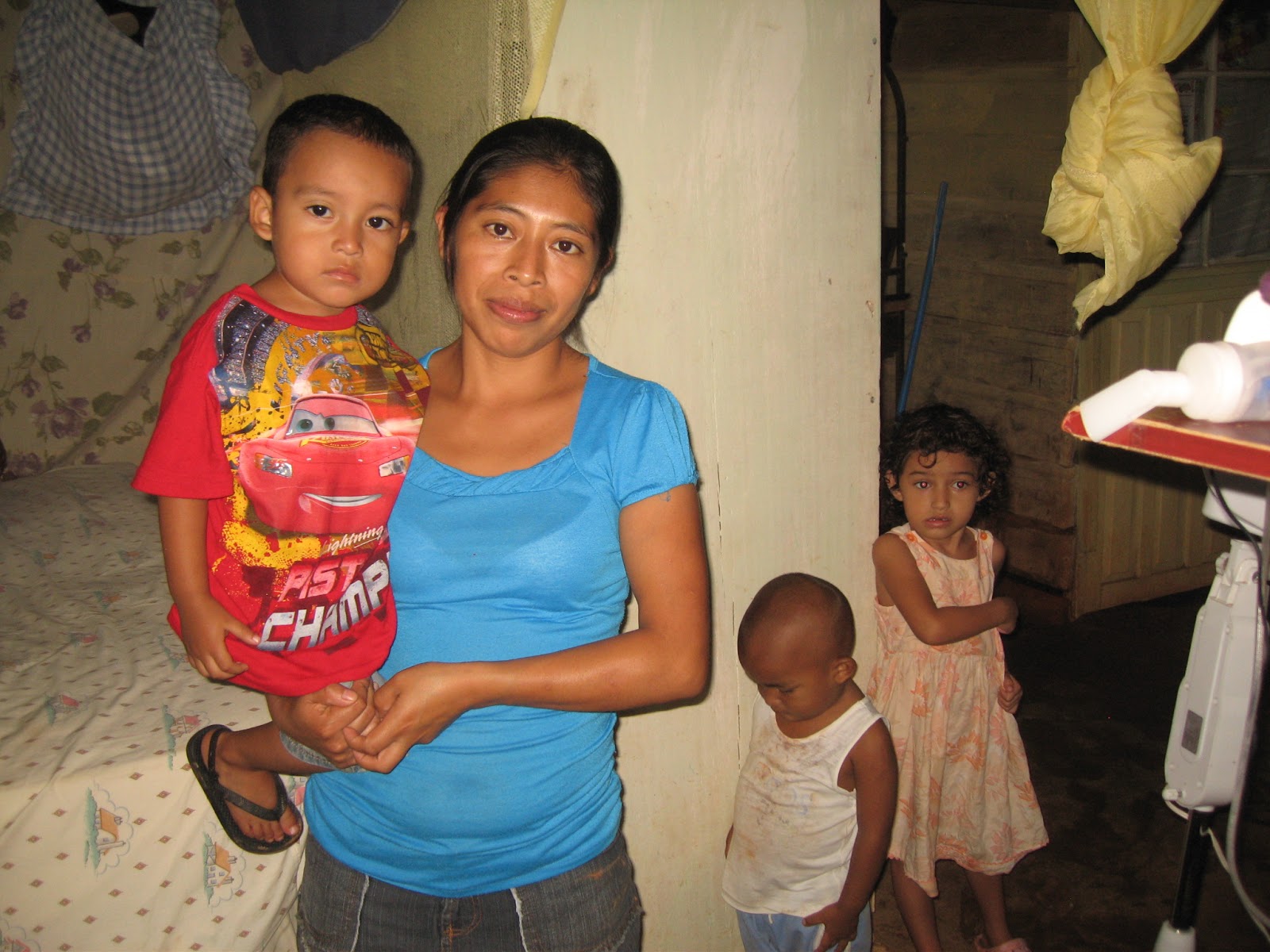
Family in Belfate Colonia
Promotora in Belfate Colonia
In January, the clinic decided to extend hours until 6pm every week night in order to reach more people. Thankfully, we’ve had an abundance of medical and non-medical volunteers to help us with the extended hours. I work the day and/or evening shift depending upon what is needed for that day. I’ve also started Spanish lessons with Vicki, a woman from the mainland of Honduras, who volunteers once a week at the clinic translating for non-Spanish speaking volunteers. I would say about 70% of our patients speak Spanish and 30% speak both English and Spanish. Therefore, it is very helpful to know Spanish, but not required for volunteers. 
On weeknights my roommate and I usually take turns making supper which I really enjoy. If you know me well, you know I love to bake, but now I'm learning how to cook because it's fun and there really isn’t much to do in the evenings. Also, if you’ve been on the Island long enough, you get tired of going out to the same touristy places that short-term volunteers want to visit. Needless to say, I’m very grateful to have a long-term volunteer as my roommate and we've become good friends. She is a long-term volunteer; working with the promotora program. Some evenings we hang out with short-term volunteers, usually playing cards or talking. For me, life is much simpler here, which I appreciate and look forward to everyday!
 

public dock near my place

Elizabeth's store (near my apartment)

 my place

Wednesday, January 30, 2013

Clinica Esperanza (Hope Clinic)

 
I realized many of you may not know the incredible story behind what God has accomplished at Clínica Esperanza. Peggy Stranges, an experienced nurse from Ohio, moved to Roatán in 2001 not really knowing what God had in store. It was not too long after she arrived on the Island when people found out she was a nurse and began lining up outside her door to seek medical advice. Peggy began seeing patients in her kitchen which later on moved into her basement. In 2007, what started out as a small clinic in Peggy’s home had moved into a new 4,000+ square foot, two-story building named Clínica Esperanza. The new clinic building was made possible by many generous donations of money, construction materials, labor, and land.
Honduran student nurses
Clínica Esperanza continues to provide healthcare to the underserved population on the Island of Roatán through donated supplies, medications, and money to purchase supplies and reduce priced medications through the World Health Organization. The cost of a visit is 70 lempiras ($3.50) which includes a 30 day supply of medications and no one is turned away if unable to pay. Typically, we treat around 60-100 patients per day, depending on how many volunteers we have for the week. The Clinic is employed by Honduran staff and there are approximately 200 volunteers a year who come to work at the clinic. The clinic has two wonderful full-time physicians, Dr. Rafael Solis (Pediatrician) and Dr. Raymond Cherryington (Family Medicine). They also have a part-time OBGYN, full-time dentist, dental assistant, receptionist, administrator, environmental service lady, and guards 24/7. There is one employee, Karla, whose been working with Peggy since 2000, when she first started seeing patients in her home and is now in the process of completing her nursing degree. I really can’t say enough good things about the employees at Clínica Esperanza. They have all been so kind and welcoming to me, despite my broken Spanish skills, which I’m working on. 
Honduran nursing students and Me


storage room with medications & supplies
   
 S
Volunteer pharmacy student working by candlelight


Dr. Raymond Cherington (Family Practice)


        Dr. Rafael Solis (Pediatrician)              

Monday, November 5, 2012

Stories from La Colonia

Children from Bella Vista
I love this picture!
It has been a good first month in Honduras; learning about the clinic, Roatán, and how to best serve the people on the Island with the resources available. I'm sure it will continue to be a constant learning process and one that requires patience when working within another culture. The article about the promotora program in the local magazine, The Voice, was published last week!! I’m hoping to post it soon, but I’m not quite sure if it will work. We shall see!

We've had joyful times this past month but also some sadness. Mrs. Flor, promotora in Bella Vista, told me at our last meeting that Jessica has gained three pounds and is full of smiles. If you remember Jessica from my last entry, she is a malnourished little girl from the Colonia, whose mother brought her and her siblings into the clinic after we visited their home in Bella Vista. The children were sent home with vitamins, anti-parasite medications, and a sack of food. Thanks to the promotora program, Mrs. Flor will be able to keep a close eye on Jessica and her family.
 
Sadly, we had a two year old boy, weighing only 13 pounds, who passed away two weeks ago. He was severely malnourished and had an extremely high number of intestinal parasites. As you can imagine, like most Latino children, he once had beautiful dark hair, but his hair had already started turning blonde; a sign of severe malnutrition. This poor little boy had no muscle tone or fat to his body; moaning and grimacing with every little movement. It was difficult to see him suffering. He was brought to our attention by a promotora that week. We delivered food and medications to him and his young mother just days before she brought him into the clinic. He had been hospitalized in Roatan’s public hospital late this summer for diarrhea, among other issues I’m sure. Many young children and adults suffer from parasites in the Colonia due to poor living conditions. As previously mentioned, the Colonia does not have any running water which makes sanitation a HUGE problem.

In Roatán, many children are at risk for malnutrition around one or two years old, when the child is no longer breastfeeding. Milk and formula are expensive, so we often find children drinking Fanta (soda) in their bottles because it can be cheaper than buying clean, drinkable water. We educate these families about not giving their children soda, most especially the young ones, when brain development is most critical. Some families know it’s not good, but can’t afford anything else and most everyone needs education on proper nutrition and development. You might think that these women should know not to give their children soda, but many women have their first child in the teens and may never have attended and/or completed elementary school. They begin parenting at a very young age and have limited or no educational resources.
By the time the little boy was brought into the clinic and even with the wonderful Pediatricians we had working at that time, he passed away the next day. As heart-wrenching and tragic as this story is, this is a reality for people suffering from poverty. It is our hope that with the promotora program we can help educate adults, within the Colonias, to identify at risk individuals much sooner than when we met this little boy so we can give them the assistance they need. I have a lot of hope for this program. These women are proud to be health care advocates for their families and communities because they realize that despite all the obstacles, it is possible to make a difference.

Tuesday, October 23, 2012

Community Outreach Program

PROMOTORA DE SALUD

I would like to tell you about one of the community outreach programs I will be involved with throughout this year and am very excited about. I will be assisting Dr. Patrick with the promotora program. Clinica Esperanza has been working hard to get this program up and running for a couple years, but have faced obstacles along the way including insufficient funds to maintain the program. The promotora program consists of non-professional healthcare individuals who receive basic health education at our clinic and then they go into their community to educate others. In addition to educating the community, the promotoras provide guidance and assistance for families in locating healthcare resources, such as Clinica Esperanza. 

La Colonia
Shortly after the devastation of Hurricane Mitch, which swept through Central America in 1998, many people from the mainland of Honduras traveled to Roatán looking for tourism jobs and a new hope for their future. According to the Economic Commission for Latin America and the Caribbean (ECLAC), Hurricane Mitch left approximately 480,000 people homeless. They began to settle on open land in the mountains and eventually these areas became known as the Colonia. Now there are approximately 5,000 people living within multiple Colonias on the Island. The Colonias are located high up in the mountains where there is no running water and living conditions are extremely poor. The “roads” leading up to the Colonia are very steep and difficult to walk especially during rainy season, which lasts from October- February. Homes are made of metal pieces, plastic, wood, and cardboard boxes. Many of the children suffer from malnutrition, parasites, malaria, dehydration, and diarrhea.

Family in Bella Vista Colonia
Last week Dr. Patrick, a volunteer medical resident, Mrs. Flor (promotora), Robert ( editor for the monthly newsletter, The Voice), and I went to visit Bella Vista, Colonia. Robert is writing an article to promote and provide awareness of the promotora program in Roatán. To give you an idea of how difficult the hills are leading up a Colonia: Dr. Patrick was forced to park our truck one forth the way up because the incline and muddy roads made it impossible to continue. We carried on by foot until we stopped to meet a family of eight. Mrs. Flor (promotora) voiced her concern for this family during the last promotora meeting. She said the family has very little food and some of the children appear to be malnourished. We came to find that the youngest child, Jessica, is suffering severely from malnutrition. She is two years old and weighs only 16 pounds! Dr. Patrick spoke with the parents on nutrition and possible food options for the children. He explained the importance of bringing Jessica to the clinic as soon as possible. What is absolutely WONDERFUL about Clinica Esperanza is that each person only pays 70 lempiras ($3.50) to be seen by a physician, which includes all medications. If a person/family is unable to pay, they are NEVER refused and they receive the exact same care. 

We had planned to do a food run this week for that family, however, the mother showed up with four of their youngest children at the clinic today. We were able to give her a sack of flour, sugar, 2 bags of beans and some rice. When I asked if she was going to take a taxi back home, she said they were going to walk... Having walked only a fraction of the distance to their home the other day, I knew it would be especially challenging for Julio, the 11 year old, to carry all that food up the hill. I offered to drive them as far up the Colonia as I could, which they were appreciative for. I will save that story for another day!


Wednesday, October 17, 2012

My journey towards Honduras!

Hello, family and friends!  I am very excited to share with you my experiences over this upcoming year at Clinica Esperanza. For those of you who would like to know more about how this all came about; I applied to Catholic Medical Mission Board (CMMB) last spring and was accepted into their medical volunteer program this summer. CMMB sends medical volunteers all over the world to work in impoverished areas. I was assigned to Clinica Esperanza in Roatán, Honduras. After speaking with a past CMMB nurse volunteer in Roatán, I decided it would be beneficial to take language courses in a spanish speaking country. I found a language school in Guatemala, booked my flight, and spent three weeks of intensive language classes. It was a wonderful experience and I met so many great people within the short time I was there, including my wonderful host family. I then flew straight to New Jersey for a week of orientation with CMMB. I was able to meet and spend time with the other women and men who are also serving as medical volunteers now. They are truly amazing people!   
In the past, I would think off and on about being a nurse volunteer in a developing country, but I never really thought I would be lead in that direction. However, life is unexpected and full of things we never thought possible. As the bible says: "With men it is impossible, but with God all things are possible.” Matthew 19:26. I feel blessed to have experienced this past month and done things I honestly never thought I could do on my own. I look forward to whatever God has in store for this upcoming year and I will share with you my journey as a nurse. I ask that you please keep the people of Roatán, the staff, and the volunteers in your prayers.
CMMB volunteers 2012-2013